Karak Castle sits on a ridge about 900 m above sea level, and its most interesting rooms are underground. You walk down into long stone-vaulted halls where the light comes through slits in the wall. Then you climb back up to the western wall, where the hills fall away towards the Dead Sea.
This was originally a Crusader, then Ayyubid and Mamluk castle. It was besieged three times by Saladin and his army and eventually fell in 1188. Further south towards Petra is the older Shobak Castle. As both are located on or close to the King’s Highway, they are often viewed by people travelling between Amman or the Dead Sea and Petra.
The short version
Karak Castle is situated in Al-Karak town and is about 140km south of Amman. Non-Jordanians are charged 2JD for admission to Karak Castle and Karak Archaeological Museum. Shobak Castle is 1JD. Both are covered by the Jordan Pass. According to the Jordan Pass, Karak and Shobak are open from 8am until 5pm although other sources state that opening times are extended in the summer and reduced in the winter. Check current times on the day. Allow 1-1.5 hours for Karak and 45 minutes to one hour for Shobak. (Admission charges from Ministry of Tourism and Antiquities, checked 26 November 2026).
Karak Castle in Jordan: what you see
The castle occupies the southern part of the old town. The lower sections are the most complete, comprising vaulted halls, passages and cells – some of which are extremely dark. Take a torch or use your phone to illuminate. The castle floor is uneven and there are many stairs so good footwear is advisable.
A walkway exists along the castle’s West Front. This allows you to look down into the valley and – on a clear day – to the Dead Sea. The Karak Archaeological Museum is also covered by the Karak Castle admission charge. In 1980 it was established in a vaulted hall of the castle. One source states that in 2019 the museum relocated to an Ottoman building outside the castle. Check at the castle gates for current information regarding its location.
What to skip: Apart from a few heaps of rubble, there is little of interest to see in the upper courtyards. Focus your efforts below ground and on the west wall.
A short history of Al Karak Castle
Construction of Karak Castle started in the 1140s under Pagan the Butler, Lord of Oultrejordain, during the time of King Fulk of Jerusalem. Usually it is stated that this occurred in 1142. Later lords of Karak constructed towers and rock-cut moats.
In 1176 Raynald de Châtillon became lord following his marriage to Stephanie of Milly. He plundered caravans on the Syria/Arabia trade route and in 1182-83 dispatched a fleet onto the Red Sea. This led Saladin to attack Karak. In 1183, whilst a wedding was being held within the castle, Saladin put Karak under siege. King Baldwin IV, accompanied by his army, then relieved the castle. Saladin attempted another siege in 1184 but eventually abandoned this after about four weeks.
Following the Battle of Hattin in 1187, Saladin executed Raynald. His army then besieged Karak once more. It eventually capitulated in 1188. Shortly after, Shobak also fell.
The Mamluks later restored much of Karak Castle. Sultan Baibars extended the castle and built a tower in the north-west corner in 1263. In 1834, Ibrahim Pasha of Egypt besieged Karak.
Shobak Castle, Jordan: the older castle near Petra
Shobak Castle is situated on a conical hill close to the town of Shobak, which is about 1,330m in elevation. Baldwin I of Jerusalem constructed it in 1115 – a year before capturing Aqaba. The Crusaders referred to it as Montreal – the royal mountain.
Whilst not in as good condition as Karak, this is also the attraction of Shobak. People explore the vaulted ruins together with the church and Mamluk walls, which feature carved Arabic inscriptions from the 14th century. The Crusaders also excavated a hillside tunnel to access subterranean cisterns fed by springs. This enabled the castle garrison to continue to obtain water during a siege. Again, a torch may be useful when exploring this tunnel.
Following 1187, Saladin’s army besieged Shobak. It fell in 1189 after almost two years. In 1261, the Mamluk Sultan Baibars captured Shobak. A later Mamluk sultan then restored the exterior walls and towers.
Shobak is about half an hour’s drive from Wadi Musa (Petra’s gate town). It can easily be incorporated into a Petra day either before or after.
Fitting the castles into the King's Highway
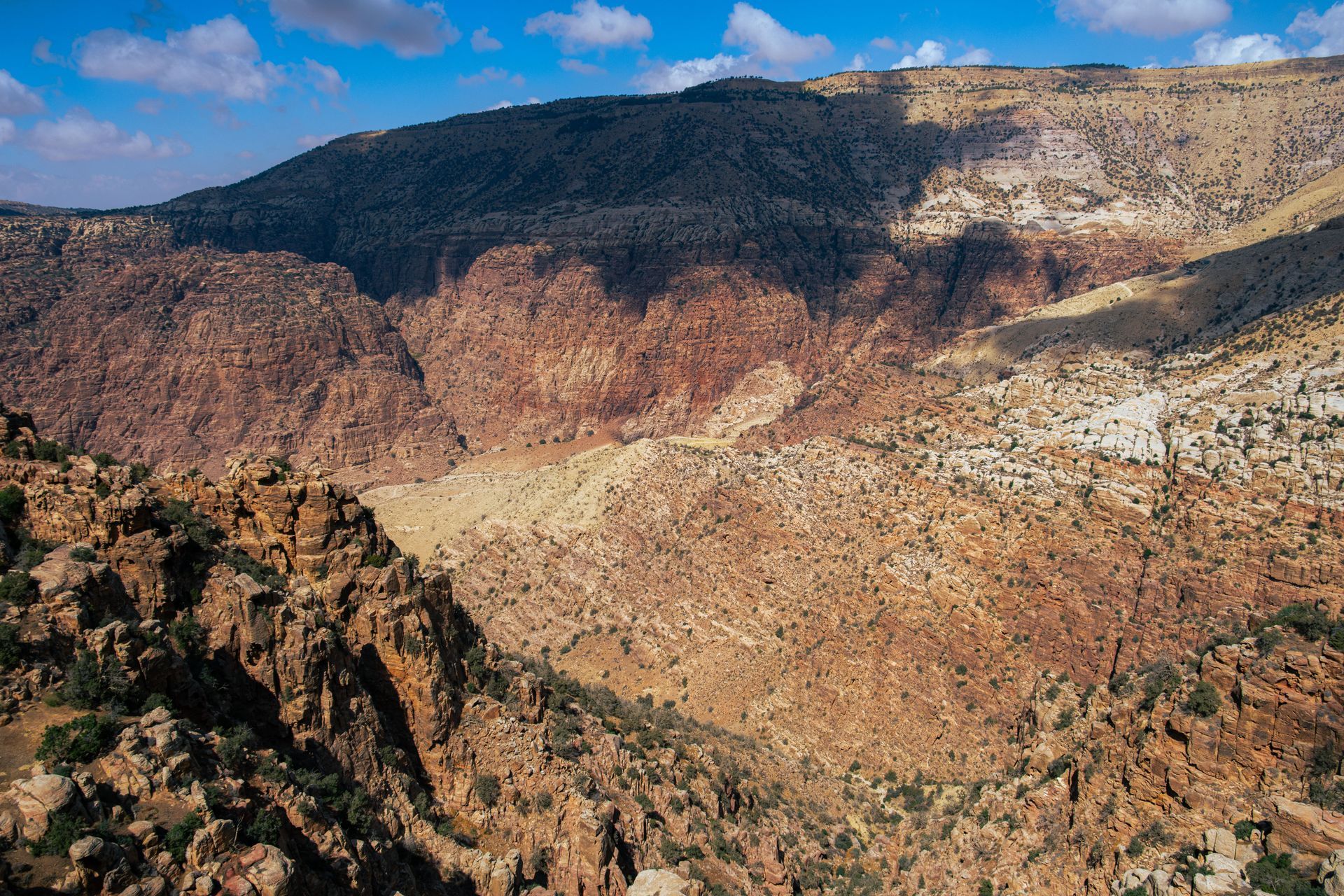
The King’s Highway heads south from Mount Nebo and Madaba and descends into the Wadi Mujib canyon. It then continues through Karak and on past Dana and Shobak to Petra. The quicker Desert Highway can be used to travel from Amman to Petra in around three hours. Including stops, the King’s Highway makes for a full day’s journey and we consider this to be the more interesting option.
Typically, the day starts in Amman or Madaba. Morning stops include
Madaba and its 6th-century mosaic map, Mount Nebo and the Wadi Mujib viewpoint. Lunch is had in Karak, together with a visit to Karak Castle. It then takes around 2.5 hours to drive to Petra. Include Shobak if there is still daylight remaining or alternatively plan to do so on a separate day from Petra.
Our tours that stop at Karak Castle
Day 3 of our
6 day Jordan tour involves travelling along the King’s Highway. Madaba, Mount Nebo and the Wadi Mujib viewpoint are all visited together with Karak Castle. Then it is about 2.5 hours’ drive to Petra for the night.
On our
7 day Jordan tour, on day 3 our driver collects you at 8:00. The day includes Madaba, Mount Nebo, the Wadi Mujib viewpoint, Karak Castle and the Dana viewpoint en route to Petra.
Our
8 day Jordan tour travels in the reverse direction. Following a free day in Aqaba, day 7 involves a drive north to Amman. Along the way Karak Castle, Mount Nebo and Madaba are visited.
All multi-day tours are a starting itinerary you can change. Should you wish to incorporate Shobak into your Petra journey or extend your time at Karak, plan a
tailor-made private tour on our
bespoke services page.
Tickets and the Jordan Pass
Karak Castle admission charge is 2JD for non-Jordanians. This also covers the Karak Archaeological Museum. Shobak Castle is 1JD for non-Jordanians. Jordanians are charged 0.25JD for admission to both Karak and Shobak Castles. (Ministry of Tourism and Antiquities, November 2026).
Both castles and the Karak Archaeological Museum are covered by the Jordan Pass. However, individually they are not sufficient reason for obtaining one. Petra and the visa fee usually are. If you are still deciding whether to acquire a Jordan Pass, see our guide on
whether the Jordan Pass is worth it.
Practical tips
- Good footwear is advisable as both castles have uneven floors and many stairs.
- Torchlight will be required for exploring Karak’s vaulted halls and Shobak’s tunnel.
- Cash in Jordanian dinars should be taken for admission charges if you do not have the Jordan Pass.
- In winter, take a warm clothing item. Shobak is over 1,300m and Karak is about 900m in elevation.
- If you have just one day for travelling, then visit Karak. Alternatively, include Shobak either in the morning or afternoon on a Petra day.
For further information on how to experience Petra, see our
essential Petra guide. Additional information on other Jordan activities can be found in our list of
things to do in Jordan.
FAQ
What is the admission price for Karak Castle?
Non-Jordanians are charged 2JD for Karak Castle admission. This also covers the Karak Archaeological Museum. (Ministry of Tourism and Antiquities, November 2026). Jordan Passes also include Karak Castle.
Is Shobak Castle covered by the Jordan Pass?
Shobak Castle is included in the Jordan Pass. Outside of a pass, non-Jordanians are charged 1JD for Shobak Castle admission.
How long should I allow for Karak Castle?
Allow 1-1.5 hours for exploring Karak Castle’s lower levels, together with the west wall and museum.
How far is Karak Castle from Petra?
By road, Karak is about 2.5 hours’ drive from Petra along the King’s Highway.
Who constructed Karak Castle?
Karak was initially constructed in the 1140s under Pagan the Butler, a Crusader lord, during the reign of King Fulk of Jerusalem. In the 13th century, Mamluk Sultan Baibars extended Karak Castle.
Is it possible to visit both Karak and Shobak Castles in one day?
It is possible, along the King’s Highway between Amman and Petra. However, this makes for a lengthy day. Generally, people view Karak en route and Shobak from Petra.
Ready to drive the King's Highway with us? See our
multi-day tours or plan your trip on our
bespoke services page.
Last updated: 26 November 2026