

Mount Nebo, Jordan: a visitor guide to the mountain of Moses
Past the bronze statue, there is a low wall on the western edge of the hilltop. From here, you can look down more than one km. The hills drop away to the Jordan Valley and finally to the grey/blue end of the Dead Sea. In clear weather, you can see the green oasis of Jericho, and beyond that, the ridge on which Jerusalem is situated.
This place is famous because, according to the book of Deuteronomy, Moses came here after 40 years in the desert, looked out over the land across the river (which he was not allowed to enter) and died. People have been coming to view this place ever since. There has been a church on the site for about 1,600 years.
The short version
Mount Nebo, often written Mt Nebo, is about 10km west of Madaba and about 50km south-west of Amman. Foreigners pay 3JD (in cash). Not included in Jordan Pass. Allow between 45-90 minutes. Best visited in the mornings. No public transport to the top of the mountain. You will need a car, taxi or driver. Can be combined with the Madaba Mosaic Map, Baptism Site and Dead Sea in one day.
Where Mount Nebo is, and how high it really stands
Mount Nebo is a range of hills on the edge of the Jordanian plateau. The church and viewing point are located on the north-western hill of the range known as Ras Siyagha. To the east lies the village of Faysaliyah and town of Madaba. To the west the land falls down towards the Rift Valley.
There are 3 different heights given for Mount Nebo in various sources online.
About 710m
This is the height of Siyagha, where the Memorial Church is located. It is the height of where you will be located in the Nebo Massif.
About 800m to 835m
The highest point of the hill range is about 100m higher than Siyagha. It is located on Jebel Neba, a short distance to the south-east.
About 1,000m and more
This is the height between the top of Mount Nebo and the Dead Sea below. The Dead Sea is over 400m below sea level. So the fall from the viewing terrace to the sea is over one kilometre.
Tickets, opening hours and the Jordan Pass
Entry fee. As of 22nd November 2026 the Jordan Tourism Board pricing lists Mount Nebo at 3JD for foreigners and 0.5JD for Jordanians. This matches with a traveller review from February 2026. However, older guides show different pricing (0.5JD or 2JD), which is no longer correct. Bring small change in Jordanian Dinar as it may not be possible to pay by card.
Jordan Pass. Mount Nebo (Memorial Church), Church of the Map (Madaba) and Baptism Site are not included in the Jordan Pass. If you have a Jordan Pass, you will need to pay separately for these sites.
Opening hours. No opening times were found on the site or from the Tourism Board, and travel guides disagree: we have seen 08:00 to 16:00, 08:00 to 17:00, and older seasonal times that run later in summer. The church may be closed to visitors during services. It is best to get there by early afternoon.
Facilities. Visitor centre where you pay, interpretation area (displaying mosaics), car park and toilets.
Getting to Mount Nebo
There is no public transport directly to Mount Nebo. Minibus services are available from Amman to Madaba, however you would still need to take a taxi for the final 10km. Taxis may be difficult to find on your way back from Nebo. Most people visit by private car so that they can combine with the Baptism Site and Dead Sea.
From Amman
About 50km. Journey time can vary between 45 minutes and 1hr depending on traffic in Amman. You travel south along the road, passing the turn-off to the airport, and into Madaba. From there, continue west to Mount Nebo. Most people make a stop in Madaba. The Mount Nebo & Madaba Tour from Amman can be taken. We pick you up from your hotel in the morning, and return you after visiting both places. Only our driver and your group will be in the car.
From Madaba
About 10km. This is a short journey. If staying overnight in Madaba, you can get to the viewpoint shortly after it opens, and before any coaches arrive. Take a taxi from Madaba. Agree a price and waiting time with your driver before getting in.
From the Dead Sea hotels
Mount Nebo is about 30km from the Dead Sea hotel complex in Sweimeh (32km according to the Mövenpick). However, the route is quite steep, rising over 1,000m, with many bends. Allow about 40-50min. It is most comfortable to make the ascent in the morning and descend in the afternoon to enjoy time in the water.
From Petra
It is quite a long journey from Petra to Mount Nebo. It takes anywhere between 3.5-4 hours along the Desert Highway, or longer if travelling along the King's Highway. It is best to include this as part of a full day trip, ending at the Dead Sea or Amman. The Petra to Dead Sea tour via Madaba and Mount Nebo includes Mount Nebo. Your luggage can be placed in the car.
When to go: light, haze and seasons
Time of day. Best in the morning. As the Jordan Valley heats up, haze lifts off the Dead Sea. By early afternoon, the distant hills may be blurred into a white line. In late afternoon, the valley can be nicely lit, however as the sun will be in front of you, photographs will be very bright and flat. For viewing purposes only, try to be in the viewpoint within the first couple of hours of opening.
Season. The best visibility tends to be after rain in winter (Dec-Mar) as the rain will have cleared dust from the air. Spring is very nice in terms of pleasant walking conditions, and greenery on the slopes. Summer can be very hot in the open viewpoint and visibility is usually worse. Try to be here early. Autumn can be variable, with some dusty days.
Crowds. Coach tours in the Madaba/Dead Sea area tend to arrive in the middle of the morning. If you arrive at Nebo shortly after it has opened, and visit Madaba after, you may have the viewpoint to yourself for a while.
What you can actually see. On a normal day, you will be able to see the Jordan Valley, northern Dead Sea and the oasis of Jericho. On a very clear day, you may be able to see hills around Jerusalem and Bethlehem. However, do not plan this trip around seeing Jerusalem. It is best to consider it as a bonus.
What you're looking at on the summit
Moses and the burial tradition
Deuteronomy 34 says that Moses was led up Mount Nebo (Pisgah) overlooking Jericho. He viewed the land and died in Moab, though we do not know where he was buried. Nebo is mentioned in both Isaiah and Jeremiah as a town in Moab. However, Christian tradition considers this spur to be where Moses died. Pilgrims were shown a "Moses tomb" from at least as early as the 380s. Muslims also respect Moses, but place his tomb on the opposite side of the valley at Nabi Musa near Jericho. However, Jewish tradition follows the text, and so does not know where his tomb is.
The Memorial Church of Moses
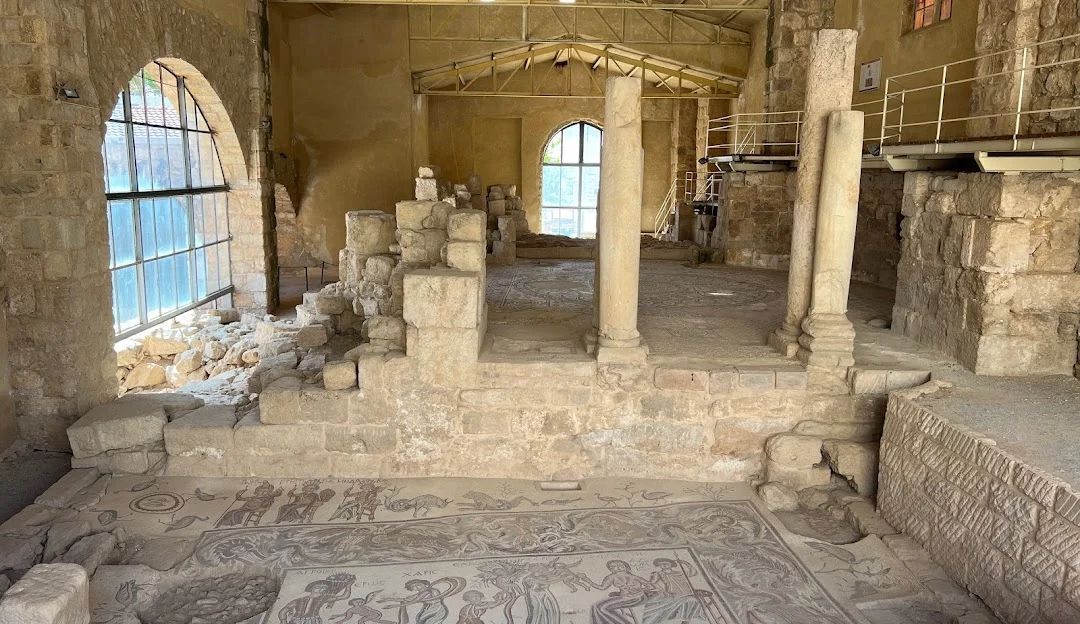
This modern church was built by the Franciscans over the Byzantine ruins to protect the mosaics. It was restored over a period of about 10 years and re-opened in October 2016.
A small church was built by the end of the 4th century. It was described in a travel journal written by pilgrim Egeria, usually dated to the early 380s. During the 5th and 6th century, monks expanded it to create a basilica, with monastic buildings surrounding it. It fell out of use, and was not used again until the 20th century.
The mosaics
The old baptistery (the Diakonikon), about 531. The large mosaic on the north wall (left side of the church) is very popular with visitors. This depicts hunting and herding scenes, including lions, a bear, boar, zebra, ostrich (on a lead), and a long-necked animal (likely intended to be a giraffe). Many of these animals would have been unknown to people in Moab in the 6th Century. Note how they have been interpreted. A Greek inscription dates this floor to 531AD. It was discovered by Father Michele Piccirillo in 1976, and was preserved under a simpler later floor.
The Theotokos Chapel, early 7th century. A small chapel dedicated to Mary was added to the church in about 604AD by Bishop Leontius. In front of the altar, two bulls and two gazelles are depicted. To the right of the image, Piccirillo interpreted the building to be the Temple of Jerusalem. There is a quote in Greek from Psalm 51 describing bulls sacrificed on the altar in the text. The chapel is small, and easy to miss. Be sure to look out for it.
Small mosaics from other churches in Khirbet al-Mukhayyat (ancient village of Nebo, just south of the site) are displayed in the interpretation centre at the entrance.
The Brazen Serpent
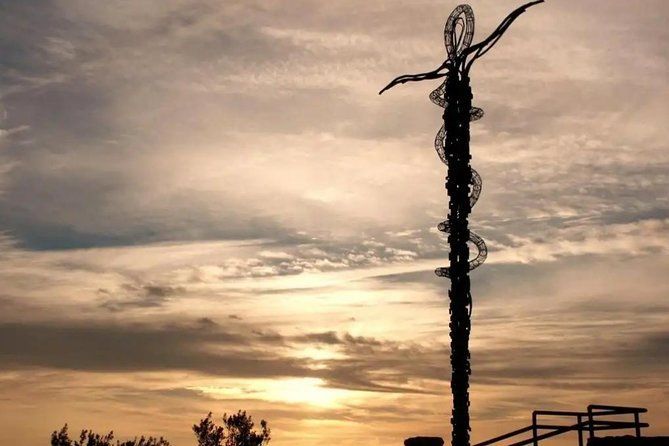
On the outside of the church on the terrace is a bronze sculpture of the Brazen Serpent entwined around a cross-shaped staff. The Brazen Serpent was raised on a pole by Moses in Numbers so that if a person was bitten by a snake in the desert, they could gaze upon it and be healed. In the Gospel of John, Jesus likens his being raised on the cross to Moses raising the serpent. This is a popular photo spot. For a clear shot of the landscape behind, try to stand to one side.
The Franciscans on Nebo
The sites at Siyagha and Khirbet al-Mukhayyat came into the care of the Franciscan Custody (the order responsible for Catholic holy sites in the region) in 1932. Excavation of the site began in 1933 by Fathers Sylvester Saller and Bellarmino Bagatti, and the Studium Biblicum Franciscanum has been working on the site since. Michele Piccirillo, the archaeologist who has done more than anyone else to uncover and understand the mosaics in this area, is buried in this shrine. The site is still managed by the Franciscans.
Papal visits
- John Paul II visited on 20th March 2000 as part of his Jubilee pilgrimage. An olive tree was planted beside the church.
- Benedict XVI visited on 9th May 2009, giving a speech in the basilica and mentioning Piccirillo by name.
- Francis visited Jordan on 24th May 2014. He visited Amman and the Baptism Site at Bethany beyond Jordan, but not Mount Nebo. There are claims he was on Mount Nebo, but according to the Vatican itinerary, this was not the case.
How long to stay, and what to wear
Time required: 45-90 mins. If you plan to just see the terrace, serpent and do a quick tour of the church, 45 mins is fine. However, to see the mosaics properly and allow the light to change, 90 mins is better.
As this is an active place of worship, ensure to dress appropriately (shoulders and knees covered) and keep your voice, and phone, quiet during services. On the terrace itself, wear a hat and bring water in the summer. In the winter, as the wind up the ridge can be cold, even if it is mild in Amman, wear a warm layer.
Day plans that work around Mount Nebo
All drive times are approximate and assume a private car.
Madaba and Mount Nebo, half a day from Amman
Leave Amman at around 8:30am. Arrive in Madaba by 9:15am. Spend an hour in St George's Church, seeing the mosaic map of Jerusalem and surrounding areas from the 6th Century. Drive for 20 mins to Mount Nebo, and you will be back in Amman by early afternoon. See our Madaba guide for suggestions of other things to do in Madaba.
Madaba, Mount Nebo and the Dead Sea, a full day
As above, but also include a visit to the Dead Sea. After visiting Mount Nebo, drive for 40-50 mins to a resort on the Dead Sea. Have lunch and a swim in the afternoon (water will be warm). Doing it this way means that the warmer part of the day is spent swimming, not walking. This is the same as our Madaba, Mount Nebo & Dead Sea tour.
Mount Nebo, the Baptism Site and the Dead Sea
From Dead Sea hotels / Amman. Visit Mount Nebo first, driving for around 40 mins to the Baptism Site (Bethany Beyond Jordan). You will be taken on a shuttle with a guide, and after 1 Nov, last admission is at 16:00. Try to arrive by early afternoon. From here it is 15 km to Dead Sea hotels. Remember that this site is also outside of the Jordan Pass.
Mount Nebo, Madaba and Umm ar-Rasas
If you love mosaics! Umm ar-Rasas, about 30km S/E of Madaba is a UNESCO World Heritage Site with an 8th Century mosaic floor in the Church of St Stephen. To see all of these sites, visit Mount Nebo first, followed by Madaba in the morning, and Umm ar-Rasas (around 45 mins drive) around noon. This makes for a very long day from Amman, but you get to see 3 of the best mosaics in the country. For information on how these mosaics relate to each other, see our Madaba Byzantine heritage page.
If planning a longer trip, see our day tours from Amman to see other itineraries our drivers offer.
Frequently asked questions
Where is Mount Nebo in Jordan?
Mount Nebo is located on the western edge of the Jordanian plateau. It is about 10km west of Madaba and about 50km south-west of Amman. It overlooks the Jordan Valley and northern part of the Dead Sea.
How much is the Mount Nebo entrance fee?
As of 22nd November 2026, the entrance fee is 3JD for international visitors, and 0.5JD for local people. Payment is made in cash at the visitor centre.
Is Mount Nebo included in the Jordan Pass?
No. It is clearly marked on the official Jordan Pass website that Mount Nebo, along with the Church of the Map in Madaba and Baptism Site are not covered by the Jordan Pass.
What are Mount Nebo's opening hours?
No official times are given on the website, and travel guides give different times, most often 8:00 to 16:00 or 17:00. To be safe, we recommend arriving early to allow plenty of time.
How do I get to Mount Nebo without a car?
It is possible to take a minibus from Amman to Madaba and then a taxi for the final 10km. As there is no bus to Mount Nebo itself, we recommend you agree a waiting time for the taxi that will take you back.
Is Mount Nebo where Moses is buried?
According to Deuteronomy, Moses died in Moab but it is unclear where he was buried. While Christians remember Moses' death on Mount Nebo, in Muslim tradition, Moses' tomb can be found at Nabi Musa near Jericho.
Can you see Jerusalem from Mount Nebo?
On very clear days you may be able to see the hills around Jerusalem and Bethlehem. On most days you will be able to see as far as the Jordan Valley, Jericho and the Dead Sea. Due to haze, you will likely not be able to see beyond this.
What time of day is clearest at Mount Nebo?
The best time to visit Mount Nebo is in the morning. Visibility in the valley is best in the morning. As coach tours typically arrive mid-morning, the best visibility is early. If visiting in the winter, after rain, visibility will be very clear.
How long do you need at Mount Nebo?
Allow around 45 mins to 1h 30 mins to see the terrace, Brazen Serpent and mosaics in the Memorial Church of Moses.
What should I wear to Mount Nebo?
As the Memorial Church of Moses is an active place of worship, it is best to wear clothing that covers your shoulders and knees. In the summer, wear a hat. In the winter, wear a warm layer as the terrace can be very windy.
Want to fit a visit to Madaba, Nebo and the Dead Sea into 1 day? We have a tour from Amman to Madaba, Mount Nebo and the Dead Sea. Check out the one day tour page for more information.
Last updated: 22 November 2026
Recent Posts