

The Dead Sea in Jordan: where it is, floating, and how to visit
As you descend from Amman, you begin to experience a change in air pressure. After a few hundred metres, you will pass sea level, and by the time you reach the Dead Sea, you will be about 440m lower than any coastal swimming you have done before.
We take guests from Amman, Petra and directly from the planes at Queen Alia fairly frequently.
The short version: The Dead Sea location is a salt lake in the Jordan Rift Valley, on the border of Jordan and the West Bank. It is about 60km (1 hour) south-west of Amman. The water is about a third salt meaning that you can float. From Jordan, you can enter either via paying for a day pass at a hotel (prices are roughly 20-75JD per adult) or at the public beach. We recommend staying in water for 10-15 minutes. Take care not to get any in your eyes or mouth. If possible, avoid visiting at the weekend.
Where is the Dead Sea?
The Dead Sea is easy to locate on a map. It is located within the Jordan Rift Valley, running from the Sea of Galilee in the north to the Gulf of Aqaba in the south. It is located at about 31°30′N 35°30′E. The entire eastern coastline belongs to Jordan. The western coastline is divided between the West Bank (in the north) and Israel (in the south), with the international border running through the middle of the water.
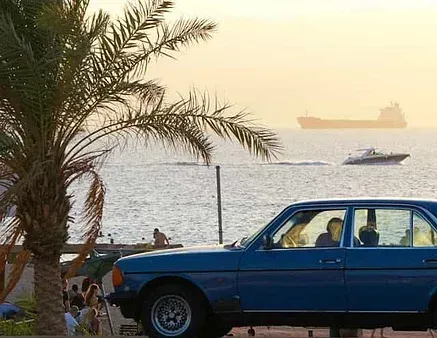
When you are in Jordan, you will be able to see the sunset over the Dead Sea, as the sun sets behind the mountainous opposite side. Most hotels in Jordan are located together in the village of Sweimeh at the northern end of the Dead Sea, meaning it is very close to Amman. Today, you are looking at the northern section of the Dead Sea. However, the southern end near Ghor al-Safi is now largely made up of evaporation pools for potash production.
Dead Sea facts at a glance
Map
Amman is located on a plateau to the north east of the Dead Sea. The road descends to hotels at the northern end of the Dead Sea. Madaba and Mount Nebo overlook from the mountains to the east. The Baptism Site is located on the Jordan River 9km north of the Dead Sea, and Wadi Mujib is located in the cliffs further south. Petra can be reached in about 3 hours from the Dead Sea.
Why can you float in the Dead Sea?
The Dead Sea has a high salinity. Whereas sea water has a salinity of around 3.5%, the salinity of the Dead Sea was measured in 2011 to be around 34%. Due to this high density of salt in the water, it is impossible for your body (mainly composed of water and air) to sink. As a result, you float in the water much like a cork.
Stand in the water to your waist, then lean backwards into a seated position. Your feet should lift up. Avoid swimming in a front position. Your legs will lift behind you, and your head will tilt down into the water, causing many people to accidentally swallow water. Instead, lie on your back and stretch your arms out.
The Dead Sea gets its name from the salinity. No aquatic life or aquatic plants can survive in the Dead Sea. Although scientists have found very small amounts of bacteria and algae in the water, and so it is not strictly true that nothing can survive in it, nothing living is visible.
Why the Dead Sea is shrinking
Between 1970 and 2025, the Dead Sea has dropped in elevation from about 395m below sea level to about 440m below sea level. The sea has dropped by about 1m per year. However, a report in 2026 found that currently, in the northern basin, the sea is dropping by about 1.15m per year.
The main reason for this is that less water is flowing into the Dead Sea. The Jordan River used to feed into the sea, however most of the water is diverted upstream for agriculture and urban areas. For example, on the western side of the Dead Sea, the National Water Carrier pipeline was completed in 1964, meaning that most of the water from the Jordan River is diverted. With no outflow, the only way water leaves the Dead Sea is via evaporation. On hot days in the summer, evaporation can cause the level of the water to drop by 2-3cm. In addition to this, the mineral extraction industries in the south pump water from the northern basin into evaporation pools, causing further loss.
You can see this issue in Jordan. In several resorts, the path to the water is getting longer each year. The water level at the beach where you float has also dropped slightly each year. Sinkholes have formed on both sides of the Dead Sea due to freshwater dissolving salt in the ground. Although it has been debated for many years to bring water from the Red Sea in pipes to the Dead Sea, this idea has been abandoned.
How to visit the Dead Sea from the Jordan side
Distances and drive times
Under normal conditions. You can drive here (good roads and English signs) or take a taxi or private driver from Amman. However, getting back on public transport in the evening can be difficult.
Dead Sea day pass or public beach?
There is an entry fee on the Jordanian side. For convenience, choose a place with showers.
Hotel day passes. Most large resorts along the Sweimeh coastline have day passes to include beach access, pools, towels, and showers. Sometimes lunch is included. Recent guides put prices at roughly 20-75JD per adult, and higher on weekends. Check prices before visiting.
The public beach. The government run Dead Sea Tourist Beach (often referred to as Amman Beach) is located along the same stretch. It includes pools and showers. It can accommodate over 4,500 people. Redevelopment of the beach started in February 2026 under a new operator. As of now prices are not published. It is busier, more local, and very busy on weekends.
If you are only going once in Jordan, we would recommend paying the day pass at a hotel to get a quiet beach, clean showers, and shade. On our day trips to the Dead Sea, hotel entrance and lunch is included.
What a private driver handles
Your driver will stay with you while you float, and have bottled water in the car. You will agree a length of time to be at the resort.
Three ways to fit the Dead Sea into a trip
Amman, Madaba, Mount Nebo, Baptism Site and the Dead Sea
This is the classic one day trip from Amman. Leave Amman at 8am and visit Madaba and see the 6th century mosaic map in St George's church. Continue to Mount Nebo (15 minutes) and enjoy the view across the valley. From Mount Nebo you will descend directly to the Dead Sea. In the afternoon we can fit in a visit to the Baptism Site (entry is 12JD for most foreign visitors and includes the shuttle and a local guide, and the visit takes up to two hours; last entry is 16:00 from November to March and 17:00 from April to October). Finally enjoy a float and the sunset.
We offer a tour from Amman including Madaba, Mount Nebo & the Dead Sea. It includes lunch and the resort, and is a driver only tour. Madaba and Mount Nebo can be explored at your own pace. If you wish to include the Baptism Site in this tour, let us know and we will give you a quotation for the changes. We have a Baptism Site guide.
On the way to or from Petra
The Dead Sea can be included in a travel day to/from Petra. Leaving Wadi Musa after breakfast, stop at Madaba and Mount Nebo. Have a float in the afternoon and continue to Amman. This is the Petra to Dead Sea & Madaba tour. It ends with you in a Dead Sea resort. Alternatively, we can add a drop off in Amman, or detour to Baptism Site.
If you are staying in Petra and wish to return the same day, this will be a long day (about 3 hours each way). The Dead Sea day tour from Petra is ideal for this.
The airport stop
Queen Alia airport is about 1 hour from the hotels. If you have a late flight from Amman, check out of Amman in the morning, have a float, shower, eat and get to the terminal in good time. If you have an early flight into Amman, head straight to the Dead Sea and sleep there. Either option can be done with a private Sedan transfer.
If you wish to do a relaxing day with nothing else to do, the Dead Sea day trip from Amman takes 1 hour both ways. It includes the resort and buffet lunch. See our tours from the Dead Sea for other options.
Wadi Mujib
Follow the Siq Trail to see a waterfall in this sandstone canyon. You will be walking, scrambling up small waterfalls using ropes/ladders and swimming. The trail takes 2-3 hours, and is self-guided. (Mujib Biosphere Reserve, RSCN)
This walk is open from April to October. In Winter, it is closed due to flash flooding and high water levels. It may be closed at short notice after rain. Minimum age is 18. You will be very wet on this walk, so make sure to wear appropriate washable clothing and footwear. Bring a dry bag. Prices (2026) are 23JD for non-Jordanians, 21JD for residents and 17JD for Jordanians. Before each season, the trail is checked for safety. Some areas require swimming.
On this tour from Amman, we include the Siq Trail in Wadi Mujib and then floating in the Dead Sea. This is important to avoid stinging the cuts you may have in the canyon. This tour is only open April to October.
Floating safely
Splashing. Avoid splashing. If water enters your nose or eyes, you may feel very uncomfortable. Doctors at Soroka Hospital in Beersheba have found that swallowing or breathing in Dead Sea water can cause imbalances in salt levels in the body, and damage to the lungs. If water gets in your eyes, do not rub them. Exit the water and flush with fresh water. Fresh water showers are available at resort beaches.
Shaving and cuts. Avoid shaving. Ideally, avoid shaving the day before, and on the day. Small cuts will sting. Use waterproof plasters to cover.
Time in the water. 10-15 minutes in the water. Then exit, shower, and re-enter later.
Footwear. The beach has a mixture of muddy, rocky and sharp salty ground. Wear flip-flops or water-wear.
Children. Small children may splash, and rub their eyes. To avoid this, hold them in the water, keeping their face dry. Let them swim in the pool.
Older travellers. Getting out of the water can be difficult. Try rolling to the side, placing your feet down, and slowly getting to your feet. Take an arm on the muddy slope.
Health. If you suffer from heart problems, high/low blood pressure, are pregnant or are taking medication which affects how you react to heat, consult your doctor.
Heat. Temperatures in summer can be very high (over 40°C). Be sure to drink plenty of water. Take breaks in the shade between floating. Avoid midday in July and August.
Local tips we give in the car
Go on a weekday. Avoid visiting on Fridays and public holidays. In Jordan, the weekend is on Friday/Saturday. During this time, Amman can be very busy at the Dead Sea. In May 2026, there was a record of over 4,000 people at the public beach in one weekend. On Sunday to Thursday, everything will be quieter.
Ramadan and Eid. Ramadan 2027 is expected to begin in early February (around 8 February) and finish in early March (around 9 March). Eid al-Fitr is on 9 or 10 March depending on moon sighting. During Ramadan, the days are quieter. Outside of resorts, avoid eating or drinking in public during daylight hours in respect of local customs. During Eid, the opposite applies. The resorts and public beach become very busy with families.
What to wear. At hotel beaches, regular swimwear is fine. However, at the public beach, many local women wear full coverage swimwear. In order to be respectful, wear a top with sleeves and shorts to the knee over your swimwear. Due to the salt and mud, it is wise to wear old dark swimwear.
Bag checks. Large resorts have a security point to check vehicles. Bags are scanned. This will take around 2 minutes.
The mud. Most resorts will have a pot of black mud. Apply to your skin, and leave to dry for 10-15 minutes. Then rinse in the sea. Many people swear this helps their skin (Note: This is not medical advice).
Sunset. As the sun is setting behind the opposite shore, the last hour of light is the time to be on the beach. For a great view, head to the Dead Sea Panorama complex on the cliff tops.
When to go
The most comfortable times to visit are in Spring (March-May) and Autumn (late September-November). Winter is still very pleasant at this altitude, even though it may be cold and grey in Amman. However, the water will feel colder. Summer should be visited early in the morning or late afternoon. The sea can be visited all year round (Wadi Mujib is closed in Winter).
Dead Sea FAQ
Where is the Dead Sea located?
The Dead Sea is located within the Jordan Rift Valley in the Middle East. It is bordered by Jordan to the east, and the West Bank to the west. On the Jordanian side it is about 60km south-west of Amman (1hr drive).
Why can you float in the Dead Sea?
The water in the Dead Sea is extremely salty (34%) meaning that it is much denser than our bodies. We can therefore float effortlessly.
How long should you stay in the water?
About 10-15 minutes. After this time, we should get out of the water, shower, rehydrate, and rest in the shade before getting back in.
How much is a Dead Sea day pass?
Day tickets at hotels on the Jordanian side cost roughly 20-75JD for adults. Prices will be higher on weekends. Check with hotels before visiting as prices will vary depending on the time of year.
Is the Dead Sea safe for children?
Keep water out of their faces. As the water is very salty it can cause a lot of irritation. Many families do not put younger children in the water.
Can you visit the Dead Sea as a day tour from Amman?
As the hotels are 1hr from Amman, a half day trip can easily be done. A full day can include a stop in Madaba, Mount Nebo or the Baptism Site.
How far is the Dead Sea from Petra?
About 188-200km (3hrs drive). Many people combine this with their travel day between Petra and Amman, and do not make a return journey.
Is Wadi Mujib open all year?
No. The Siq trail is only open between April and October as it is closed in winter due to flash flooding. Minimum age is 18.
Why is the Dead Sea shrinking?
Most of the water from the Jordan River is used upstream. In addition, water is pumped from the sea into evaporation ponds to support mineral industries. This means that the sea level drops by about 1 metre per year.
If you would like to plan your own route, let us know what dates you are travelling, and where you are staying, and we can advise you on how to fit in the Dead Sea: contact us.
Last updated: 22 November 2026
Recent Posts